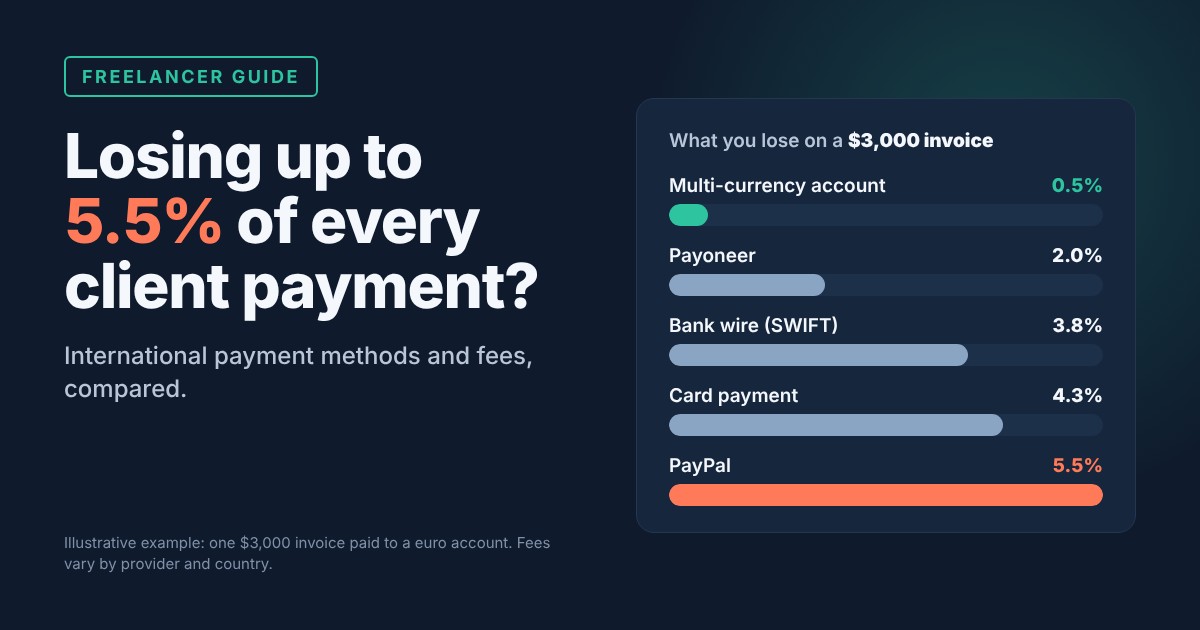
The short answer: for most freelancers, the cheapest way to get paid by international clients is to receive money into a multi-currency account (such as Wise or Revolut Business) through local bank rails like ACH or SEPA, and to convert to your home currency only when you need to. That usually costs well under 1% in total. PayPal and card-based methods are convenient but often cost 4–7% once currency conversion is included, and traditional international bank wires sit in between with unpredictable fixed fees.
This guide explains every major way to collect an international payment, what each one really costs, and which one to choose for your situation. The examples use a Spain-based self-employed freelancer (autónomo) invoicing clients in the United States and the European Union, but the principles apply to freelancers in most countries.
Fee note: payment fees change often and differ by country, account type and corridor. The figures below are typical ranges based on provider pricing pages and published comparisons as of October 2026. Always confirm the current numbers on the provider’s own pricing page before you quote a client or set up an account. This article is general information, not tax or legal advice.
International payment methods and fees at a glance
| Method | What you typically pay | Speed | Best for |
|---|---|---|---|
| Multi-currency account with local details (Wise, Revolut Business, similar) | Free to receive by local rails (ACH, SEPA); about $4–7 per incoming USD wire or SWIFT; conversion about 0.4–0.7% on major currency pairs | Same day to 2 days | Direct clients, retainers, regular invoices |
| Payoneer | Free from other Payoneer users and many marketplaces; up to about 1% on payments received from non-Payoneer clients; possible annual fee if volume is low; conversion margin on withdrawal | 1–3 days | Marketplace payouts (Upwork, Fiverr, Amazon) |
| Traditional bank wire (SWIFT) | Sender fee roughly €15–40, possible intermediary fees, your bank’s receiving fee, and a 1–4% exchange rate margin | 2–5 business days | Large one-off payments, clients who insist on bank transfers |
| SEPA transfer (euro payments within Europe) | Usually free or a few cents | Same day to 1 day | Any client paying in euros inside the SEPA area |
| PayPal | Around 3–3.5% plus a fixed fee, an extra cross-border percentage, and a conversion spread of about 3–4% if currency is converted | Instant to receive, 1–3 days to withdraw | Small payments, clients who only use PayPal |
| Stripe or card invoicing | About 1.5–3.25% plus a fixed fee, depending on the card, plus about 1% if converted | 2–7 days to payout | Clients who want to pay by card, subscription work |
| Freelance platform payout (Upwork, Fiverr) | Platform commissions of 10–20%, plus withdrawal fees | Varies | Finding clients, not cheap collection |
| Cryptocurrency or stablecoins | Network fees are small, but converting to local currency costs about 0.5–2%; tax reporting is more complex | Minutes to hours | Clients who already pay in crypto |
The differences look small on a percentage basis, but they compound. On $36,000 of annual international income, a 5% method costs $1,800 a year; a 0.5% method costs $180.
What to compare before you choose
A headline fee tells you very little. When you evaluate a way to get paid, look at these six things.
- The receiving fee. Some methods charge nothing to receive, others take a percentage or a fixed fee per payment. Receiving by local rails (ACH in the US, SEPA in Europe, Faster Payments in the UK) is usually free; receiving by SWIFT usually is not.
- The exchange rate. This is where most of the money is lost. A provider can advertise «no fees» and still apply a margin of 2–4% on the exchange rate. Compare the rate you are given with the mid-market rate you see on Google or a currency site.
- Fixed fees per transaction. A $6 fee on a $5,000 invoice is negligible. The same fee on a $150 invoice is 4%. If you invoice often in small amounts, fixed fees matter more than percentages.
- Speed and predictability. Some transfers arrive in minutes. Others pass through intermediary banks and arrive three to five days later with some of the money missing. If you need to know exactly how much arrives, choose a method that shows the final amount before the client pays.
- What your client has to do. A method that is cheap for you but confusing for your client will delay payment. Clients in the US are used to ACH; clients in Europe are used to SEPA; large companies often only pay by bank transfer to an account they can verify.
- Limits, verification and account risk. Payment providers can pause an account for a compliance review, especially after a large first payment. Check the verification requirements, the holding limits and the support options. Do not rely on a single provider as your only way of getting paid.
A useful rule: the cost of a payment is the receiving fee, plus the exchange rate margin, plus the fixed fee, plus the cost of moving the money to your own bank account. Add all four before you compare.
How to receive international payments: the main methods explained
1. Multi-currency accounts with local account details (Wise, Revolut Business and similar)
These services give you bank details in other countries, for example a US routing number and account number, a euro IBAN and a UK sort code. Your client pays you as if you were a local business, and the money lands in your account in the client’s currency.
Why it works: payments made by ACH, SEPA or Faster Payments are generally free to receive, and you keep the money in the original currency until you decide to convert it. Conversion fees on major currency pairs have typically been in the range of roughly 0.4% to 0.7%, though they vary by pair and can be higher for less common currencies.
What to watch: wire and SWIFT payments into a US dollar account usually carry a small fixed fee (reports put it around $4 to $7 per payment). Some providers charge a one-time fee to open account details in certain currencies or regions, so check what applies to your country. Large or early payments can trigger a compliance review, so verify your account fully and keep contracts and invoices ready. Availability also varies by country, and some services have restrictions in specific markets.
Best for: direct clients, retainers and anyone who invoices regularly in a foreign currency.
2. Payoneer
Payoneer is built around marketplaces. Many platforms, including Upwork and Fiverr, can pay you into a Payoneer account, and it can also issue receiving details so that direct clients can pay you.
Typical costs: payments from other Payoneer users and many marketplaces are free or low-cost. Payments received from clients who are not on Payoneer, through the receiving accounts, can cost up to about 1%, and withdrawals to your bank add their own fee and an exchange margin. Some account types have an annual fee if your yearly volume is low. Because Payoneer’s pricing differs by country and account type, read your own fee schedule.
Best for: freelancers who get most of their income from marketplaces or who work with clients that already use Payoneer. For direct clients, compare it carefully with a multi-currency account.
3. Traditional international bank transfer (SWIFT)
The classic method: the client’s bank sends a wire to your bank through the SWIFT network. You provide your IBAN and BIC/SWIFT code.
Typical costs: the client’s bank may charge a sending fee (often roughly €15–40), one or more intermediary banks can deduct fees along the way, your bank may charge a receiving fee, and your bank converts the money at its own rate, often with a margin of 1–4% over the mid-market rate. The payment can take two to five business days and the amount received can be lower than the amount sent.
How to reduce the pain: ask the client to send with the «OUR» charge option so that the client’s bank covers the fees, and ask for the payment in your account currency to avoid conversion at your bank. If you receive in a different currency, open a foreign currency account at your bank or use a multi-currency account instead.
Best for: large one-off payments, corporate clients whose finance departments only use standard bank transfers.
4. SEPA transfers (for payments in euros within Europe)
If your client is in the SEPA area and pays in euros, this is the simplest option. SEPA credit transfers are usually free or very cheap, arrive within a business day, and there is no currency conversion at all. Ask clients based in Europe to pay by SEPA transfer to your euro IBAN, and where possible, invoice them in euros.
5. PayPal
PayPal is familiar to clients and fast to set up, but it is one of the most expensive ways to get paid internationally.
Typical costs: a business account pays a percentage plus a fixed fee on each commercial payment (published fee pages for Spain and the eurozone show figures around 2.9% plus a fixed fee). Cross-border payments can add a further percentage. If the payment arrives in a currency other than your account currency, PayPal applies a currency conversion spread that is often around 3–4%. Together, a converted international payment can easily cost 5–7%.
How to limit the damage: use a PayPal business account, ask clients to pay in your account currency where possible, avoid automatic conversion, and withdraw to a multi-currency account in the same currency if your provider supports it. Use PayPal only when the client insists or when the payment is small.
6. Stripe and card invoicing
Stripe and similar processors let you send an invoice that clients pay by card, often with Apple Pay or Google Pay. This is convenient for clients and suitable for subscriptions or retainers.
Typical costs: card fees vary by card type and region. In Europe, standard pricing has been around 1.5% plus a fixed fee for European consumer cards and higher for non-European cards, plus a conversion fee of about 1% when currencies differ. Payouts usually take a few days. You can decide to add a surcharge or incorporate the fee in your rate, but check local rules on card surcharges first.
Best for: clients who prefer to pay by card, and recurring billing.
7. Freelance platforms (Upwork, Fiverr and others)
Platforms are a way to find clients, not a way to save money on payments. Commissions are typically in the range of 10% to 20% of your earnings, and they add withdrawal fees on top. If a platform client wants to continue working with you directly, check the platform’s terms before moving the relationship off-platform.
8. Cryptocurrency and stablecoins
Some clients, especially in tech and web3, pay in stablecoins such as USDC. Network fees are low and settlement is fast, but you need an exchange or provider to convert to local currency, which usually costs around 0.5–2%, and exchange rates can move between the invoice date and the conversion date if you are not holding a stablecoin. Tax treatment of crypto income is more complicated in many countries, and in Spain it involves additional reporting obligations. Accept crypto only if you understand the tax consequences and keep full records of every transaction.
The hidden cost of international payments: currency conversion
The biggest difference between payment methods is rarely the visible fee. It is the exchange rate. The mid-market rate is the real rate between two currencies, the one you see on a currency converter. Any provider that gives you a lower rate is keeping the difference as a margin.
To measure the margin on any conversion, use this simple calculation: take the mid-market amount, subtract the amount you actually received, and divide by the mid-market amount. If you should have received €2,760 and you got €2,655, the margin was 3.8%.
Two habits remove most of the problem:
- Check the rate before you accept it. Compare the offered rate to the mid-market rate at the same moment.
- Hold the foreign currency and convert on your terms. If you receive dollars into a dollar balance, you can convert when the rate suits you and when you have a real need for euros, rather than being forced into a conversion on the day the money arrives.
Worked example: one $3,000 invoice
Assume you invoice a US client $3,000 and you want the money in euros. For illustration, the mid-market rate is 1 USD = 0.92 EUR, so the «fair» amount is €2,760. The assumptions below are typical, not guaranteed; real figures depend on your provider and country.
| Method | Assumed costs | You receive | Total cost | Cost as % |
|---|---|---|---|---|
| Multi-currency account via ACH | No receiving fee, 0.5% conversion | €2,746 | €14 | 0.5% |
| Payoneer | About 1% receiving fee, about 1% conversion margin | €2,705 | €55 | 2.0% |
| Traditional bank wire | $40 combined sending and intermediary fees, 2.5% bank margin | €2,655 | €105 | 3.8% |
| Card payment via Stripe | About 3.25% card fee, plus 1% conversion | €2,643 | €117 | 4.25% |
| PayPal | About 5.5% all-in (fees plus conversion spread) | €2,608 | €152 | 5.5% |
The gap between the cheapest and the most expensive option is about €138 on a single invoice. If you issue one $3,000 invoice every month, that is roughly €1,650 a year from the choice of payment method alone, before any tax.
Should you invoice in your currency or the client’s?
If you invoice in the client’s currency, the client has no conversion cost, but you take the exchange rate risk and must convert. If you invoice in your own currency, you avoid conversion but the client may pay more if their bank adds a margin, and some clients dislike it. For a stable price, many freelancers invoice in the client’s currency, receive it into a multi-currency account, and convert in batches. If a client’s currency is unstable relative to yours, consider invoicing in a more stable currency such as USD or EUR, or include an exchange-rate clause in your contract.
Which way to get paid internationally is best for you?
| Your situation | Recommended method | Why |
|---|---|---|
| Direct clients in the US paying in dollars | Multi-currency account with US account details, paid by ACH | Free to receive, low conversion cost, familiar to US clients |
| Direct clients in the EU paying in euros | SEPA transfer to your euro IBAN | Free or near free, no conversion if you hold euros |
| UK clients | Multi-currency account with UK details (Faster Payments) | Fast and cheap for local transfers |
| Income from Upwork, Fiverr or other marketplaces | The platform’s recommended payout, usually Payoneer or a local bank withdrawal | Often the only supported or cheapest option on that platform |
| A client who only pays by PayPal | PayPal, with the fee built into your rate | Avoids losing the client; account for 5–7% in your price |
| A large corporate client with strict payment rules | Bank wire (SWIFT), paid with the OUR option | Corporate finance teams often only use bank wires |
| Subscriptions or retainers paid by card | Stripe or a similar processor | Automatic billing, good client experience |
| Clients in countries with currency controls or volatile currencies | Invoice in USD or EUR, receive into a stable-currency account | Protects you from local currency swings |
A simple setup that works for most freelancers
- Open a multi-currency account and get local account details for the currencies your clients use most (typically USD, EUR and GBP).
- Keep one backup option, for example a second provider or a foreign currency account at your bank.
- Add your account details to your invoice template so clients can pay by local transfer.
- Convert to your home currency in batches, when the rate is acceptable, and keep a monthly record of the rate used for tax reporting.
- Use PayPal or card payments only when a client cannot pay another way, and price the fee into your rate.
Invoicing, paperwork and tax basics
Getting paid cleanly starts with a good invoice. Whatever method you use, include the following so that your client can pay quickly and your records are in order.
- Your legal name or business name, address and tax ID, and the client’s legal name, address and tax or VAT ID where relevant.
- A unique invoice number and the issue date.
- A clear description of the service, the amount, and the currency, written in words as well as symbols (for example, «USD 3,000»).
- The payment method and full bank details: for a local transfer, the account number and routing or IBAN; for SWIFT, the BIC/SWIFT code and the bank name and address.
- The due date and your late payment terms.
- A note on who pays bank charges, for example «all bank fees to be paid by the sender.»
Tax and reporting: the points to check
The tax treatment of international income depends on your country of residence, the client’s country and the type of service. The points below are the ones most freelancers should verify with a qualified adviser.
- Declare the income. Income from foreign clients is generally taxable where you are tax resident, regardless of how you were paid. Keeping the money in a foreign provider’s account does not make it invisible to the tax authority.
- VAT or sales tax. For clients in other EU countries, you often invoice without VAT under the reverse-charge rules, and you may need to be registered in the intra-community operators register and file the related declarations. For clients outside the EU, services are often outside the scope of local VAT, but the rules depend on the type of service and the client’s status. Check the rules before issuing the first invoice.
- Withholding forms from US clients. US companies commonly ask non-US freelancers for a Form W-8BEN to confirm their foreign status and, where a tax treaty applies, claim a reduced withholding rate. A freelancer who provides services performed outside the US is often not subject to US withholding, but the form is still usually requested.
- Exchange rate used for tax. Tax authorities usually require you to convert foreign currency income into your home currency, using a defined rate. Keep a record of the date, the amount in the original currency and the rate used.
- Foreign accounts. Some countries require residents to report foreign bank accounts above certain thresholds. In Spain, for example, there are specific information declarations for foreign accounts and assets above set limits, so check whether your multi-currency account falls within them.
- Keep your records. Save invoices, contracts, payment confirmations and conversion statements for the period your country requires, typically at least four to six years.
If your international income is more than a small share of your revenue, a one-hour consultation with an adviser who knows cross-border rules is inexpensive compared with the cost of a mistake.
Common mistakes to avoid
- Accepting the first method the client suggests. Clients often propose PayPal or a bank wire out of habit. Offer a cheaper alternative on your invoice; most clients will use it.
- Letting the payment converter choose the rate. Receiving in a currency you do not hold usually triggers the least favorable conversion. Hold the currency and convert deliberately.
- Ignoring fixed fees on small invoices. A flat fee of $6 is 6% of a $100 invoice. For small invoices, batch the work or use a method without a fixed fee.
- Depending on one provider. Accounts can be paused for verification. Keep a second option and a small balance in your regular bank account.
- Not building fees into your rates. If a client insists on PayPal, price the fee in. It is a cost of doing business with that client, not a loss you should absorb.
- Forgetting to record exchange rates. You will need the rate and date for each payment when you file your taxes.
- Moving the client off a platform without checking the terms. Some platforms prohibit this and can close your account.
- Mixing personal and business funds. Use a separate account or balance for business income so your records are clean.
Frequently asked questions
What is the cheapest way to receive money from a foreign client?
For most freelancers, it is receiving by local bank rails (ACH in the US, SEPA in Europe) into a multi-currency account, then converting only when needed. For euro payments inside Europe, a plain SEPA transfer to your own IBAN is usually free.
Is PayPal a good way to get paid internationally?
It is convenient and familiar to clients, but it is usually the most expensive option once fees and currency conversion are added. Use it when you must, and price the cost into your rate.
How long does an international payment take?
Local transfers such as ACH or SEPA usually take from a few hours to two business days. SWIFT wires typically take two to five business days. Marketplace payouts and card payments depend on the platform and can take several days.
Do I need a company to receive international payments?
Not necessarily. Many freelancers receive payments as individuals or sole traders, but some providers have different rules for personal and business accounts, and some clients prefer to pay a registered business. Check your provider’s rules and your country’s registration requirements.
Should I invoice in dollars or in my local currency?
If your clients pay in dollars and you want a stable relationship, invoice in dollars, receive them into a dollar balance, and convert in batches. If your income and expenses are in your local currency and you prefer predictability, invoice in your local currency and accept that the client may bear an exchange margin.
What is a mid-market exchange rate?
It is the midpoint between the buy and sell prices of a currency pair on the global market, and the best rate to compare against. Any difference between the mid-market rate and the rate you receive is a hidden fee.
Do I have to declare money held in a foreign payment account?
Yes, the income is generally taxable, and some countries also have reporting requirements for foreign accounts above certain thresholds. Ask a qualified adviser what applies in your country.
Can I get paid in cryptocurrency?
Yes, but the tax treatment is more complex and you must record every transaction. Convert to a stable local currency promptly unless you have a clear reason to hold crypto, and check the reporting rules in your country.
Sources and how to verify fees
Fee figures in this article are approximate ranges drawn from provider pricing pages and published comparisons found in search results (October 2026). I did not open the full pages, and some of the comparisons are from third parties, so confirm every figure on the provider’s own pricing page before publishing or acting on it.